To celebrate St. Joseph’s Day, we wanted to approach the devotion that St. Candida had to this special saint. We believe that it may help us to follow her experience in order to “reflect” on our own.
We do not have much data, but we do find images of St. Joseph that have passed through the “retina” of his eyes and, I would say with certainty, also through that of his heart, since his childhood.
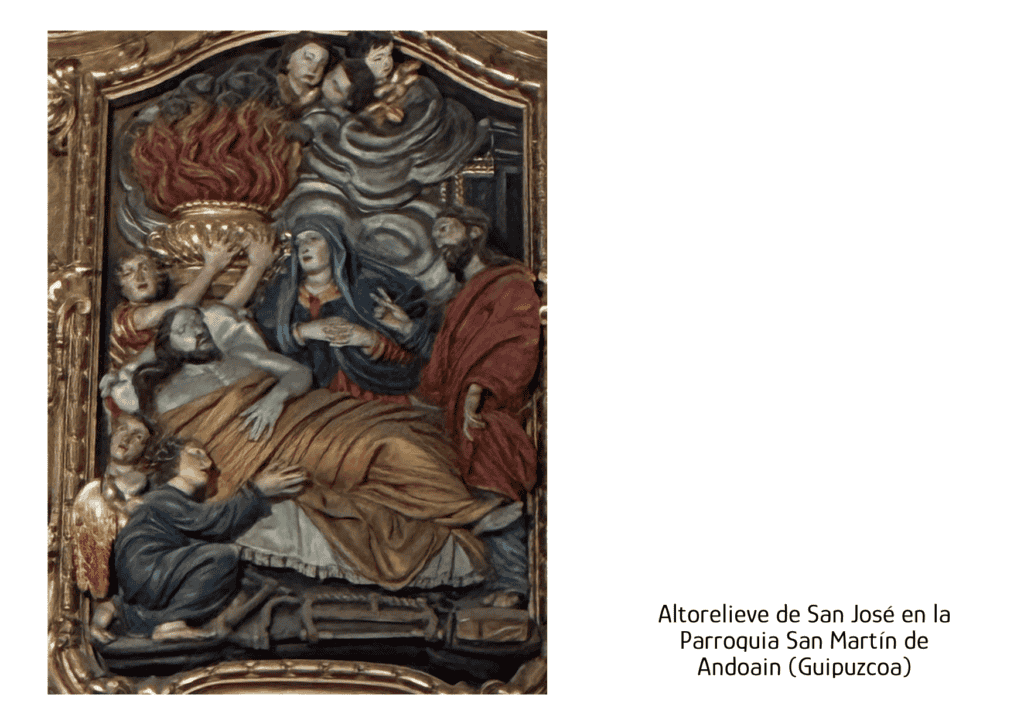
We find an image of St. Joseph, more specifically of his death, assisted by Jesus and Mary, in the right high relief of the parish of Andoain, the town where she was born and the parish where she was baptized on the same day she was born, May 31, 1845.
In Toulouse, we know well how Juana Josefa, still a child, in the parish of St. Mary, before the image of St. Ignatius, expressed“My Saint, I want to do what you say in that book”.
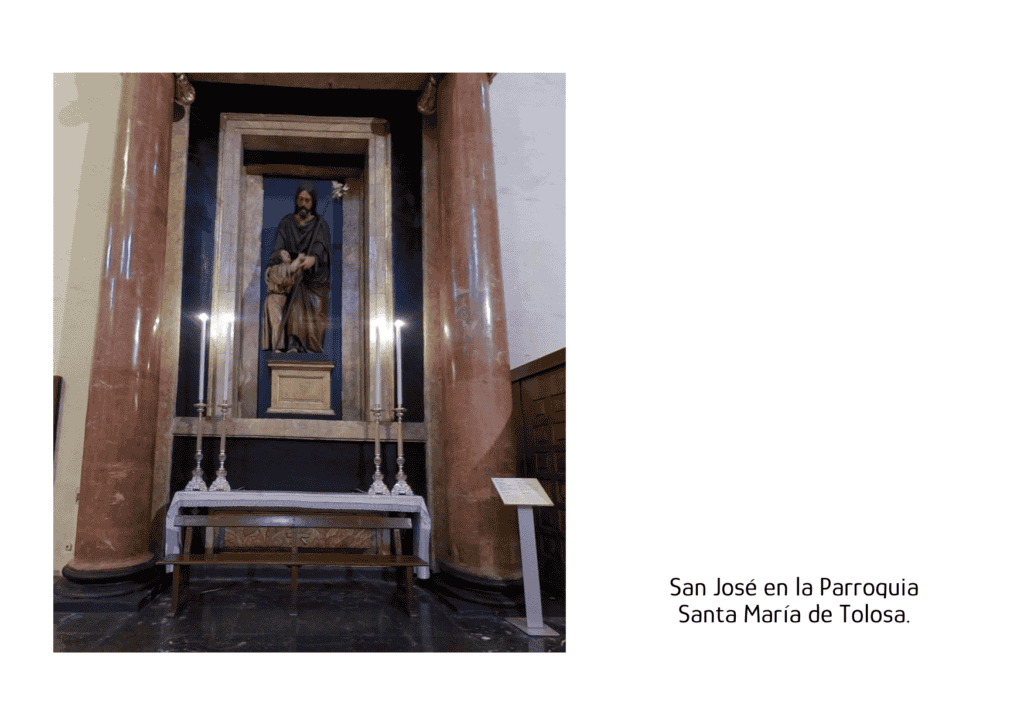
Well, next to that of St. Ignatius, on the right, is the altar dedicated to St. Joseph. On it is an image of St. Joseph, carrying his flowery staff and accompanied by the Child Jesus. How many times, even as a child, would you not stop before that image! Would you also say something to him?
St. Joseph: a living presence in history and in our hearts
What we do know is provided by a brief report which states the following:
“During the stay at the Palace there were no classes other than St. Joseph’s for boarders and half boarders and St. Ignatius, for free eternals.”
That is to say, later on, as a foundress, she gave the first classes in Toulouse the names of St. Joseph and St. Ignatius. Nice relationship, isn’t it?
In the book “Spirituality of the Mother Foundress” we find:
“The saints occupy an important place in her life, we find here again her basic spiritual position following the Church. The saints for her are her intercessors, her protectors, they are also models for her imitation in her degree, as were Christ and the Virgin. As a result of these devotions comes a whole set of acts of worship with the profusion typical of the time. The devotion to St. Joseph is the one that lives with greater intensity. It thus responds to the mind of the Church, which then especially patronized and spread it.” (pg. 108)
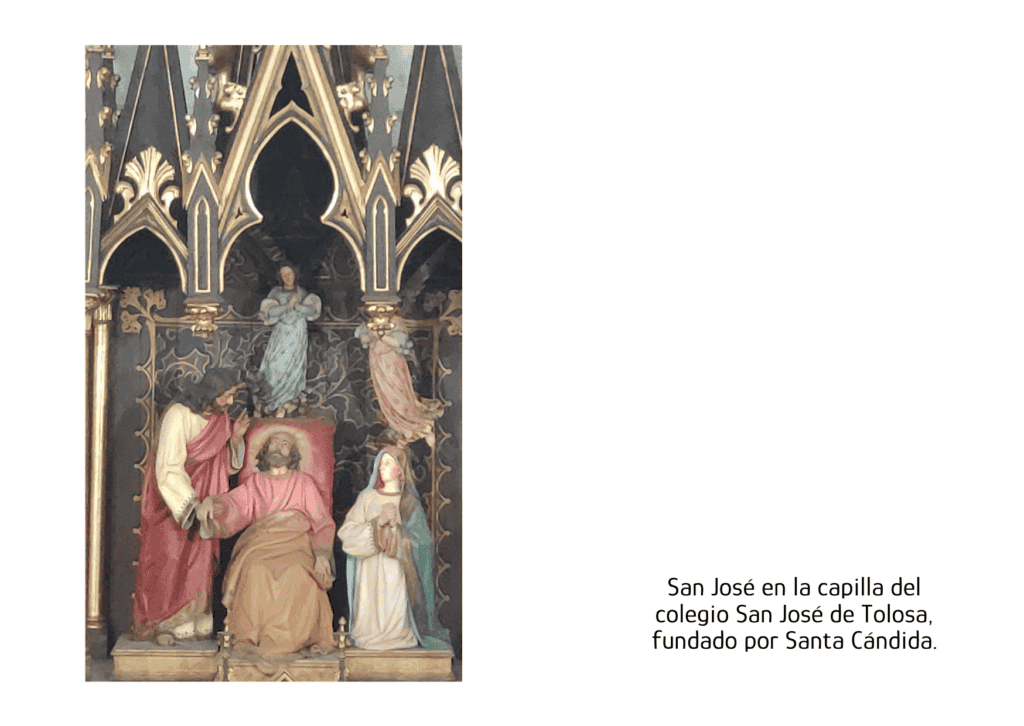
And among the pages of the “History of the Congregation” that speak of Toulouse, after speaking of the delay with which the work on the chapel was progressing, we can read these beautiful words about the altarpiece that M. Candida herself commissioned for the main altar and which represents the death of St. Joseph:
“The beautiful images of the altarpiece that would preside over the main altar had arrived well in advance. It was April 29, 1902. A group of three sculptures representing the death of St. Joseph. Let us gather from the diary of the house the impression that they experienced when they received it: <The images of the death of St. Joseph came; precious…; we were taking them out of the drawers… the first one they took out was that of the Virgin…, we liked it very much; then they took out that of the Lord, we also liked the same, but above all when they took out St. Joseph we were enchanted with him; then we formed the group and it was magnificent. Father Vicar came and could not get tired of seeing it…>” (History of the Congregation. Vol I.page 280)
Let us continue our journey to St. Joseph’s side through the “gaze” of M. Candida. Candida.
St. Joseph was also found:
– In the second first name of our beloved Saint Candida.
– In the Rosarillo Altarpiece, on the right, looking towards Jesus. This beloved altarpiece contemplated so many times by Juana Josefa in her daily and intense prayer, until she experienced the light of the foundational inspiration.
– In the niche on the façade of the house where the congregation of the Daughters of Jesus was born and which is called “Casa de San José” (St. Joseph’s House).
– In more than 30 letters, in which Sr. Candida alludes to St. Joseph, especially by commending him, thanking him, encouraging her to trust him or asking for his intercession for some difficult situation.
– She named several schools founded by her after St. Joseph: Tolosa (Guipuzcoa), Pitillas (Navarra), Coca (Segovia) and Medina del Campo (Valladolid).
Mother Candida had a deep devotion to St. Joseph, considering him a constant and discreet protector in her life and educational mission. She lived under the protection of St. Joseph, to whom she had recourse as confidant and guide in difficult moments of the foundations.
In Toulouse, especially, he propagated the devotion to St. Joseph as the patron of the good death. St. Joseph is traditionally invoked as the patron of the good death for dying in the arms of Jesus and Mary, representing a calm and prepared transit.
We can see Mother Candida’s intense devotion to St. Joseph, and perhaps as a fruit, also in the experience of her own death before which she expressed: “I die very calmly and peacefully”.
Certainly, that of St. Candida…, a whole life at St. Joseph’s side. 1
Today we can also “have St. Joseph by our side”.
Devotion to St. Joseph is booming today, spurred by Pope Francis and the search for hope in times of uncertainty.His intercession is counted on as protector of the family and work, custodian of the Church, model of timely silence and protector of the good death. His “sleeping” figure stands out, inviting us to always have confidence in God. It represents silent obedience to God’s will and trust in providence in the midst of crises.
And you, do you dare to always trust in God like St. Joseph?
- The CIC is very grateful for the collaboration, on this occasion, of Sisters Ana Zubiri fi and María Jesús Esnal fi, who corroborated the data and provided images. Ana Zubiri fi and María Jesús Esnal fi, who have corroborated our data and provided us with images. And also to those who have asked for help themselves. ↩︎