The Silent Legacy of Father Herranz in the Early Days of the Daughters of Jesus
In the early history of the Daughters of Jesus, there are names that, though not in the spotlight, were instrumental in helping God’s dream take root. One of them is that of the Jesuit Fr. Miguel San José Herranz, whom we remember today with special gratitude.
Her presence alongside Saint Candida was not that of someone directing her own work, but rather that of someone who knew how to accompany, listen, discern, and help another person discover and fulfill God’s will. He even helped the young Juana Josefa Cipitria y Barriola (who would later become Mother Cándida) learn Spanish when she was still barely familiar with the language. He was her spiritual guide during the decisive moments of her vocation; a close collaborator in drafting the Rule of Life and the first Constitutions of the Congregation, inspired by those of the Society of Jesus. He was the one who welcomed her in Salamanca on December 6, 1871; he presided over the celebration marking the founding of the Congregation of the Daughters of Jesus on December 8, 1871; and he remained attentive, close, and present to the congregation in one way or another until his death.
His support was unassuming, steadfast, and deeply rooted in the Gospel.
When being there for someone also means letting go
That assistance was not without its difficulties. In some circles, it was frowned upon for a Jesuit to be so closely involved in the founding of a women’s congregation. The Society’s own Constitutions advised against ordinarily assuming the spiritual direction of communities of religious women, precisely to preserve the universal availability of the Jesuits.
In 1872, the new provincial decided to assign Fr. Herranz to Galicia, sending him away from Salamanca at a time when the Constitutions were still being drafted and the fledgling Congregation was taking its first steps.
The account handed down through tradition recounts a deeply moving moment: the pain of parting, Fr. Herranz’s obedient acceptance of the mission, and the strength with which St. Candida encouraged her first companions to press on, convinced that “God is our Father and will not abandon us.”
The mission continued, even though the way we supported it had changed.
A Lesson in Letting Go and Inner Freedom
The order to move to Galicia came unexpectedly. Fr. Herranz did not question the assignment or try to delay it. Convinced that he must immediately comply with what was asked of him, he went to say goodbye to the community while a brother was already arranging the tickets for his departure that very afternoon.
However, Saint Cándida clearly sensed that God still had one last gift in store for the fledgling Congregation. She was convinced that Fr. Herranz should not leave without investing the first Daughters of Jesus who were preparing to take that step. And so it happened: the tickets could not be obtained that day, and the celebration was able to take place before his departure.
When recalling that moment, Mother Cándida does not emphasize the change of plans, but rather Father Herranz’s inner attitude. She writes that “Father Herranz’s ever-serene face reflected the pain that the order he had received had caused him, but his will was marked by a resolute determination to carry it out without delay.” That total willingness served as a true spiritual lesson for her: “I received this sublime lesson as a gift, and with surrender and trust, I tried to live out those events.”
In the days leading up to his departure, Fr. Herranz prepared the first sisters with special care. He encouraged them to live out the vocation they had received with gratitude, to remain faithful to the spirit of the new Institute, and, above all, to cherish unity among themselves. More than a farewell, these were days dedicated to passing on a spiritual legacy that would continue to accompany the Congregation long after his departure.
A handkerchief that holds a story
The distance did not put an end to that companionship.
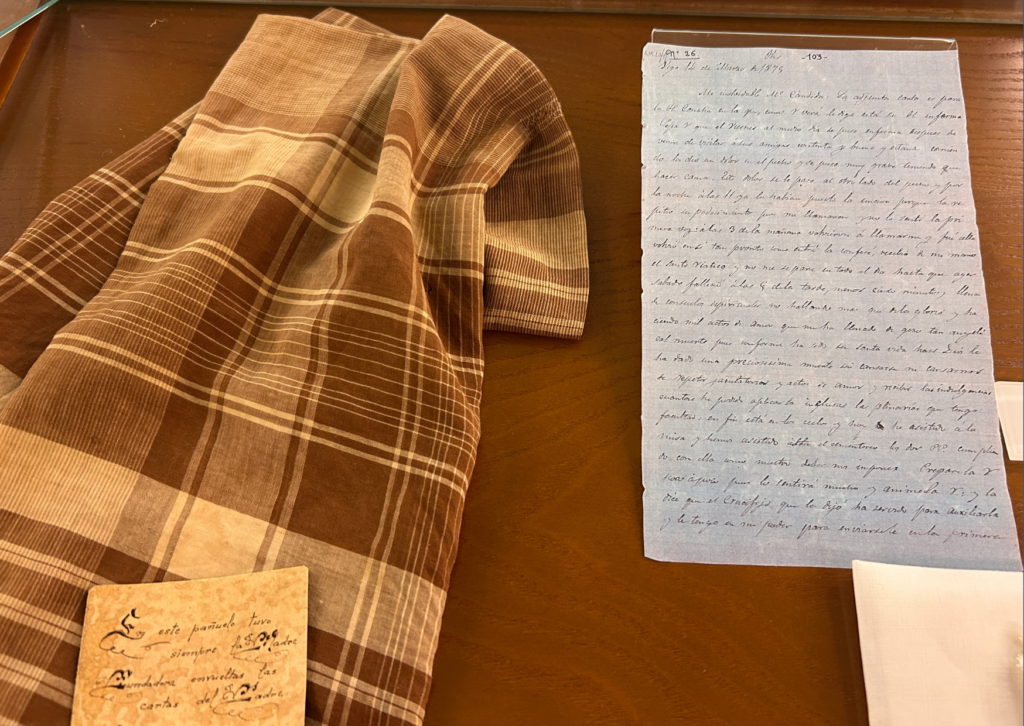
From Galicia, an intense correspondence began between Fr. Herranz and Mother Cándida. Over the years, more than two hundred letters passed between them, offering advice, insight, encouragement, and discernment to a Congregation that continued to grow.
Those letters were not merely an exchange of news; rather, they were a true space for spiritual accompaniment and a shared search for God’s will.
Saint Candida kept them carefully hidden in a simple handkerchief, which we still preserve today in our exhibition space in Rome as a precious relic of our origins.
That scarf speaks of trust, of fidelity, and also of the discretion with which the two of them nurtured a relationship that some did not understand, but which bore abundant fruit for the Church.
The courage to always seek God’s will
The story of Father Herranz and Saint Candida reminds us that great works almost always arise from simple relationships lived with depth.
He speaks to us of a form of accompaniment that does not create dependence, but rather freedom; of help that spurs us on to grow; of obedience that is not resignation, but a willingness to follow God’s call even when the paths change unexpectedly.
It also tells us of a saint who remained faithful to the mission she had been given, creatively and prudently seeking ways to continue a process of discernment she considered essential. And of a Jesuit who accepted his assignment with complete willingness, while continuing—from a distance and in silence—to support the work he had helped bring into being.
A legacy that continues to inspire us
Today we give thanks for the life of Fr. Miguel Herranz and for the gift of his presence during the early days of our Congregation.
Her way of walking alongside others continues to inspire us to walk with others in a spirit of respect, listening, and discernment; to trust that God continues to write history even when plans change; and to believe that relationships built on the Gospel leave a much deeper mark than any desire for the spotlight.
We feel that that old handkerchief preserved much more than just some letters and means much more than the role it played; it holds the memory of a spiritual friendship that helped make the founding of the Daughters of Jesus possible and that continues to remind us that God’s will is often discovered as we walk together.